DCS Tournaments was created to provide a competitive environment where DCS World pilots can compete in structured, fair and professionally organized dogfight events. Our tournaments are played on specially prepared PvP missions designed exclusively for air-to-air combat. Competition formats range from classic 1 vs 1 engagements, through coordinated 2 vs 2 team fights, up to dynamic 3 vs 3 battles. Each tournament follows a clearly defined rulebook covering aircraft selection, weapon limitations and victory conditions to ensure maximum transparency and equal opportunities for all participants. Our goal is to create a space where pilot skill, tactical coordination and aircraft mastery truly matter — without the randomness and chaos of public servers.
TOURNAMENT RULEBOOK
SATAC 5
1. Match Format
- 5 vs 5 – air-to-air combat
- Best of three rounds
2. DCS Version
- All matches are played on the latest DCS version
- Teams are responsible for keeping their game updated
3. Maps
- Caucasus
- Persian Gulf
- Syria (optional)
4. Team Composition
- One team per squadron
- 5 primary pilots
- Maximum 1 mercenary per match (ASES @Merc role required)
- Mercenary pilots may not compete against their own squadron
5. Allowed Aircraft
F-16C, F/A-18C, F-15C, F-15SE, F-14B, JF-17, Su-27, Su-33, MiG-29, J-11A (PL-12 only)
6. Weapons & Equipment
- Maximum 6 FOX-3 missiles
- Maximum 8 air-to-air missiles total
- TGP/Litening pods allowed
Prohibited: 9x zoom, ECM, air-to-ground weapons, TALD/decoys
7. AWACS
- Group stage – AWACS enabled by default
- Playoff stage – optional disable by coin toss decision
8. Round Rules
- No respawn after “GoGo” command
- Crash after takeoff counts as round loss
- Shot-down pilots must disconnect
- Maximum 2 minutes to enter combat zone
9. Victory Conditions
- All enemy aircraft neutralized
- At least one surviving pilot must successfully RTB
10. Organization & Streaming
- Server available 15 minutes before match start
- Airboss/Streamer controls match settings
- Streams may have 1–2 minute delay for fairness
11. Fair Play
- No exploits or unsportsmanlike behavior
- Penalties or disqualification may apply
- Final decisions belong to tournament organizers
SATAC 6
1. ENTRY
- Matches are 6 vs 6
- Squads are strongly encouraged to maintain reserve pilots. A mercenary pool is available for teams short on pilots.
2. Available aircraft
- F-14, F-15C, F-16, F/A-18, JF-17, MiG-29, Su-27, Su-33 (PL-12), J-11 (PL-12)
3. FIGHT IN THE ZONE
- Engagement takes place within a bullseye-centered bubble.
- Once entered, aircraft must remain until the opposing team is neutralized. Re-entry after exit is not permitted.
- A 5-minute entry window begins when the first aircraft enters the bubble.
- Any team with aircraft outside after this period will forfeit the round.
- Use of invalid weapons (upon firing or entering the bubble) results in round forfeiture.
- Once airborne (gear up), any disconnect or incident counts as a loss.
4. FORMAT MECZU
- Best of 3 (group stage),
- Best of 5 (knockout stage).
- Wsparcie AWACS jest dostępne wyłącznie w fazie grupowej.
- AWACS support is available in group stages only..
- In final rounds, AWACS is disabled; GCI support via LotATC is provided instead.
- Fighter-to-fighter datalink is enabled for Flanker aircraft
5. GROUP STAGE
- AWACS support is available.
- Matches are played in a best-of-3 format.
- The winner squad with same amount of points, will be determined by the total number of aircraft successfully returned across all flown matches.
6. FINAL STAGE
- AWACS-fed datalink is disabled, human GCI support will be provided via LotATC
- Fighter-to-fighter (peer-to-peer) datalink remains enabled.
- Matches are played in a best-of-5 format.
7. SPORTMANSHIP
- MERCENARIES: Maximum of 2.
- BVR: roll-bug in all aspects - NOT ALLOWED.
- BVR: max rolling angle allowed - 450° per roll.
- MERGE: within 10km - Free maneuvers.
- JAMMERS: blinking manually or by macro - NOT ALLOWED (5sec interval rule).
- Squads are allowed to fly with no jammers if both parties agree.
8. NOTE !
- Pilots accused of breaking the rules will be required to provide their server tracks for review.
- If anyone is observed using bugs, exploits systematically, it will be judged at any range or situation, even within 10km.
- The decisions made by moderators on this matter are not up for disputes.
9. PAYLOAD
- Maximum: 4x Active radar homing missiles (all types).
- No AIM-9X
- No Air to Ground weapons.
10. WEATHER
- Variable weather: Clouds, Fog, wind, wake, and time of day. Selected by dice roll during live-stream.
MATCH CALENDAR
Click on the event to go to the details
TACTICS
Air-to-Air Radar (BVR) – Fundamentals
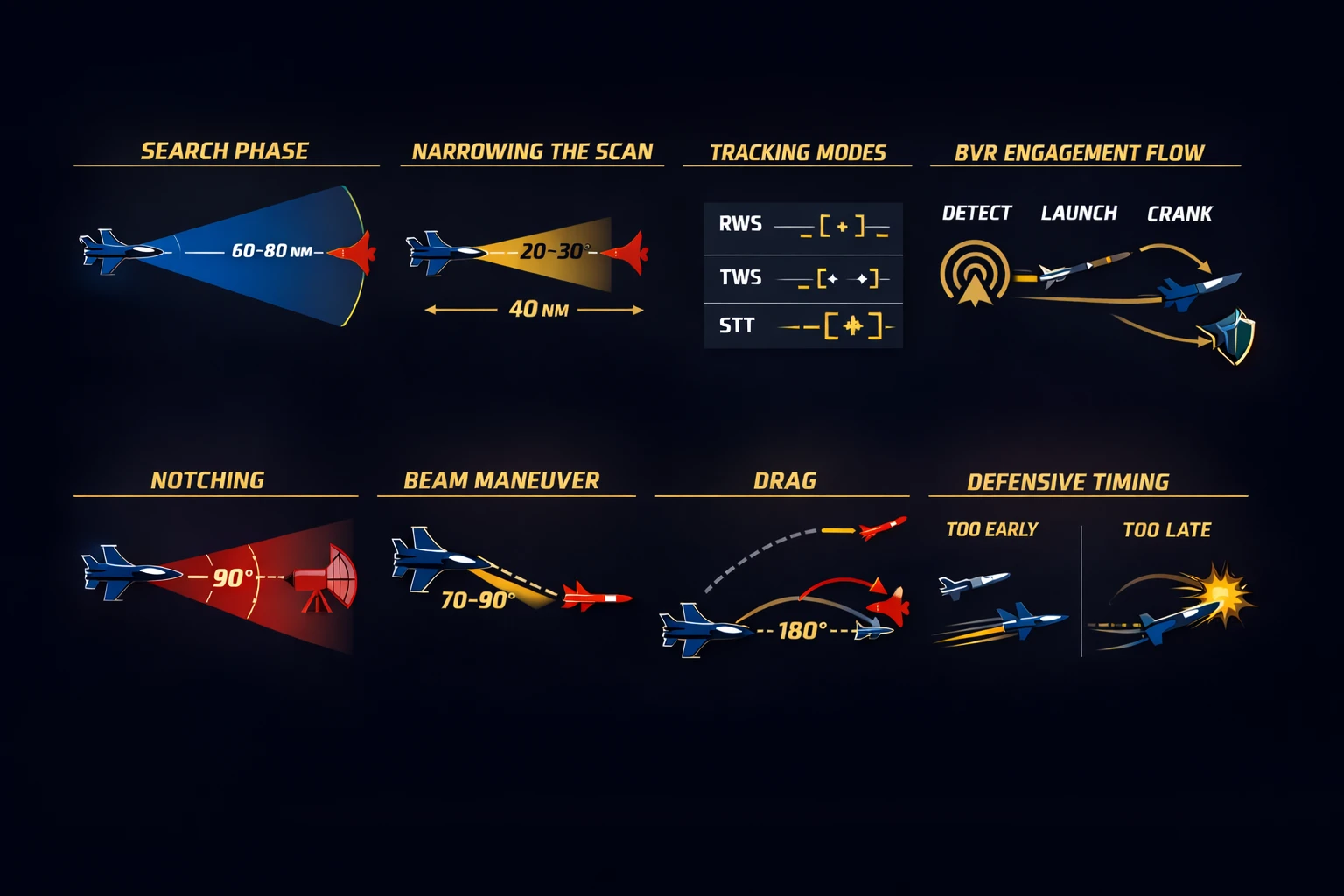
The radar is the primary tool for Beyond Visual Range (BVR) combat. Regardless of aircraft type (F-16C, F/A-18C, F-15, Su-27, MiG-29, JF-17), the core principles are similar and focus on proper range control, scan width management, and antenna elevation.
1. Search Phase
- Set wide azimuth (50–60°)
- Use 2–4 scan bars
- Initial range 60–80 nm
- Continuously manage antenna elevation
The objective of this phase is early detection and tactical awareness. Excessively narrow scanning reduces situational awareness.
2. Narrowing the Scan
- After detecting a target, reduce range to 40 nm
- Narrow azimuth to 20–30°
- Reduce to 2 bars for faster refresh rate
Narrowing the scan sector increases update speed and improves fire control solution accuracy.
3. Tracking Modes
- Search Mode (RWS/SEARCH) – detection phase
- Track While Scan (TWS) – multi-target tracking
- Single Target Track (STT) – precision lock on one target
In tournament environments, TWS combined with active radar missiles (FOX-3) is most commonly used. STT is typically reserved for the final phase of engagement.
4. Typical BVR Engagement Flow
- Detect target at 50–70 nm
- Narrow the scan sector
- Engage within optimal zone (25–35 nm)
- Execute a 30–40° crank maneuver
- Transition defensive once the missile goes active
5. Common Mistakes
- Maintaining wide scan during the attack phase
- Poor antenna elevation management
- Switching to STT too early
- Flying too low during the offensive phase
Radar combat effectiveness depends on tactical discipline, energy management, and coordinated teamwork.
Defensive Techniques (BVR Survival)
Defensive maneuvering in BVR combat is critical in tournament PvP environments. Proper timing and execution can neutralize an enemy missile while preserving energy and tactical positioning.
1. Notching (Doppler Defeat)
- Turn perpendicular (90°) to the attacking radar
- Maintain level flight to use ground clutter
- Deploy countermeasures if required
Notching minimizes closure rate relative to the enemy radar, making it difficult for pulse-Doppler systems to maintain tracking. It is especially effective against semi-active and active radar-guided missiles.
2. Beam Maneuver
- Offset 70–90° from the threat direction
- Maintain altitude and monitor time-to-impact
- Be prepared to transition into full defensive maneuvering
The beam maneuver reduces missile closure rate and forces the opponent to commit deeper into contested airspace. It is often used as a transition before executing a notch or drag.
3. Drag (Defensive Extension)
- Turn cold (180° away from the threat)
- Maximize speed while preserving altitude
- Force the missile to bleed energy
Dragging is used when survival becomes the priority over continued offense. Extending away at high speed increases missile time-of-flight and reduces its terminal energy.
4. Defensive Timing Principles
- Do not defend too early – maintain offensive pressure
- Do not defend too late – respect missile active range
- Communicate defensive transitions with teammates
- Preserve energy whenever possible
In 5 vs 5 environments, defensive discipline often determines the outcome. Surviving the first missile exchange frequently decides the engagement.
Advanced Defensive Concepts
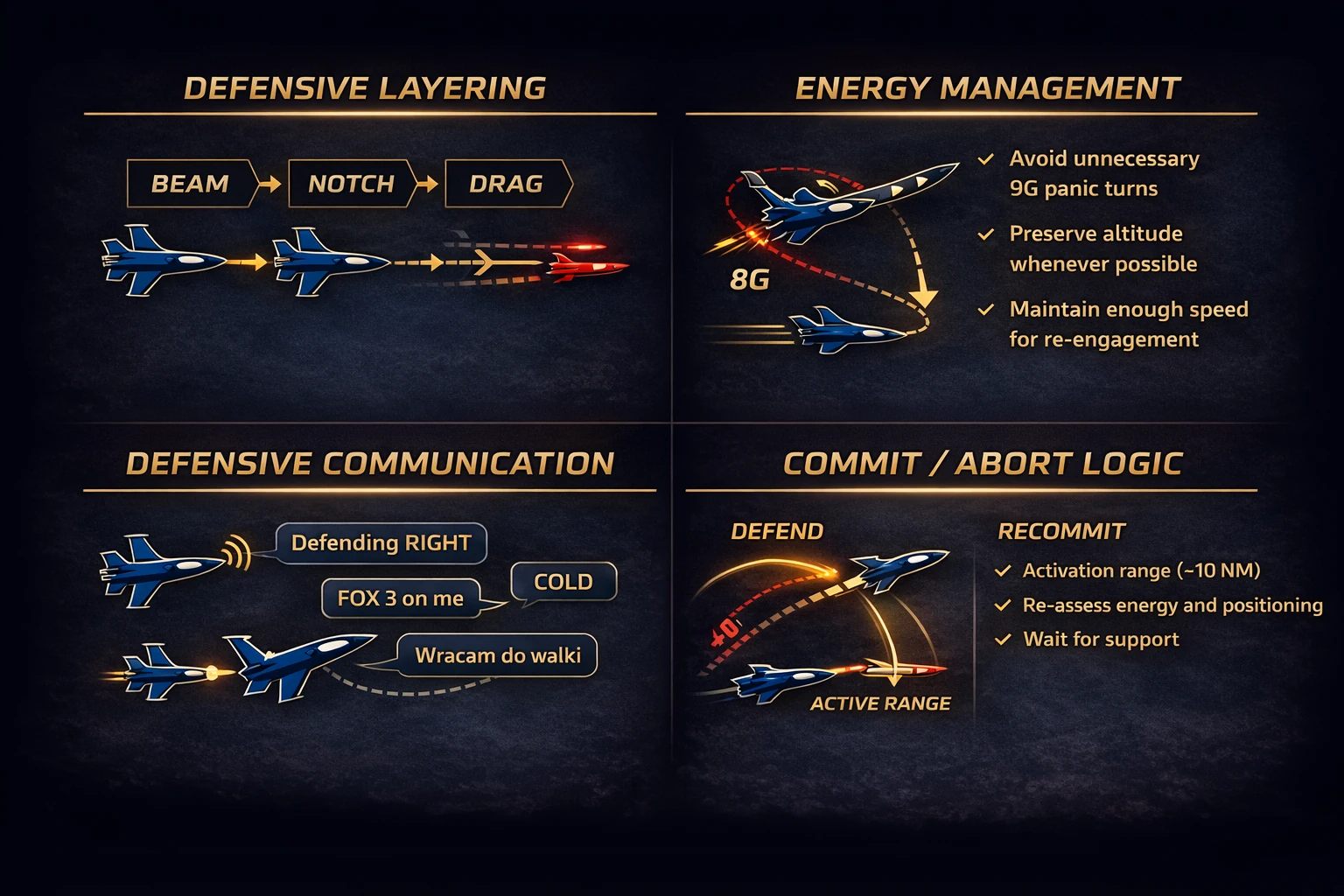
High-level PvP engagements require more than basic defensive maneuvers. Advanced defensive discipline combines timing, energy control, and coordinated teamwork.
1. Defensive Layering
- Beam first to reduce closure rate
- Transition into a proper notch at the correct timing
- Extend (drag) if missile energy remains high
Defensive survival is rarely a single maneuver. Layering multiple techniques increases the probability of defeating active radar missiles in tournament environments.
2. Energy Management During Defense
- Avoid unnecessary 9G panic turns
- Preserve altitude whenever possible
- Maintain enough speed for rapid re-engagement
Winning teams are not those who simply survive, but those who recover energy faster and re-enter the fight first.
3. Defensive Communication
- Call "Defending left/right"
- Call "Fox 3 on me"
- Announce "Going cold" or "Re-engaging"
Clear defensive calls allow teammates to apply pressure, support, or reposition without confusion. Lack of communication is one of the most common causes of round losses.
4. Commit / Abort Logic
- Defend once the missile approaches active range
- Recommit only when energy and positioning allow it
- Never recommit alone without team support
Structured commit and abort decisions prevent unnecessary losses and maintain tactical integrity in 5 vs 5 engagements.
PILOT TRAINING
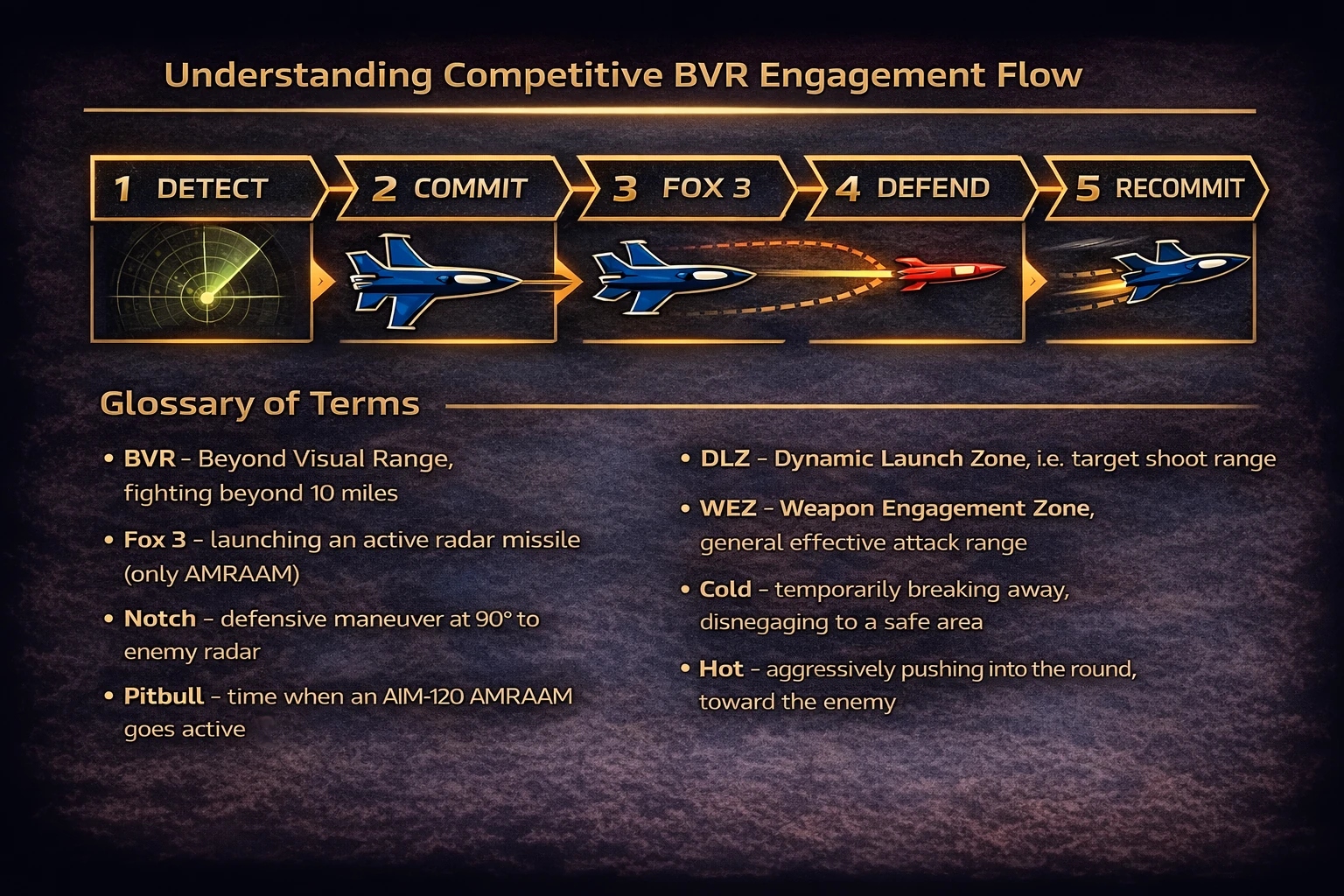
Quick Start – What a Typical 5 vs 5 Round Looks Like
Every tournament round follows a structured process. Understanding its stages is essential for new pilots.
1. Takeoff and Climb
- After takeoff, build altitude and speed
- Maintain formation with your team
- Establish a plan before entering the combat zone
2. Enemy Detection
- Use wide radar scan mode
- Build situational awareness
- Do not commit alone
3. First Missile Exchange
- Launch within optimal range
- Execute a crank or offset maneuver
- Prepare for defensive reaction
4. Defensive Phase
- Beam / notch / drag depending on the situation
- Communicate maneuvers with your team
- Preserve energy
5. Return to Offense
- Rebuild altitude and speed
- Re-enter the fight together with your team
- Exploit numerical advantage
Basic Rules for New Pilots
- Fly high and fast – energy is life
- Never attack alone
- Always assume a second missile is inbound
- Communication is more important than a perfect maneuver
- Surviving the first exchange often determines the round
Common Beginner Mistakes
- Defending too early
- Flying too low before the first shot
- Lack of team communication
- Committing without support
- Panic 9G turns without energy management
Pre-Match Checklist
Before every tournament round, pilots should verify the following elements. Preparation reduces mistakes and increases team consistency.
Aircraft Setup
- Correct fuel load
- Allowed missile configuration (according to tournament rules)
- Radar and weapon systems tested
- Countermeasures properly configured
Team Coordination
- Assigned formation (lead / wing / bracket pair)
- Initial altitude and speed plan
- Commit direction agreed
- Abort and defensive call logic confirmed
Mental Preparation
- Stay calm during the first exchange
- Prioritize survival over aggressive solo plays
- Trust your teammates
Standard Radio Calls
Clear and short communication is critical in competitive 5 vs 5 environments. Use standardized calls to avoid confusion.
Offensive Calls
- "Fox 3, 30 miles, bandit west"
- "Cranking left"
- "Recommitting"
Defensive Calls
- "Defensive right"
- "Fox 3 on me"
- "Beaming"
- "Cold"
Support Calls
- "Supporting you"
- "Pressing hot"
- "Covering your drag"
- "One bandit low / high"
Short, standardized communication increases reaction speed and reduces team errors during high-pressure moments.
How to Survive Your First Tournament
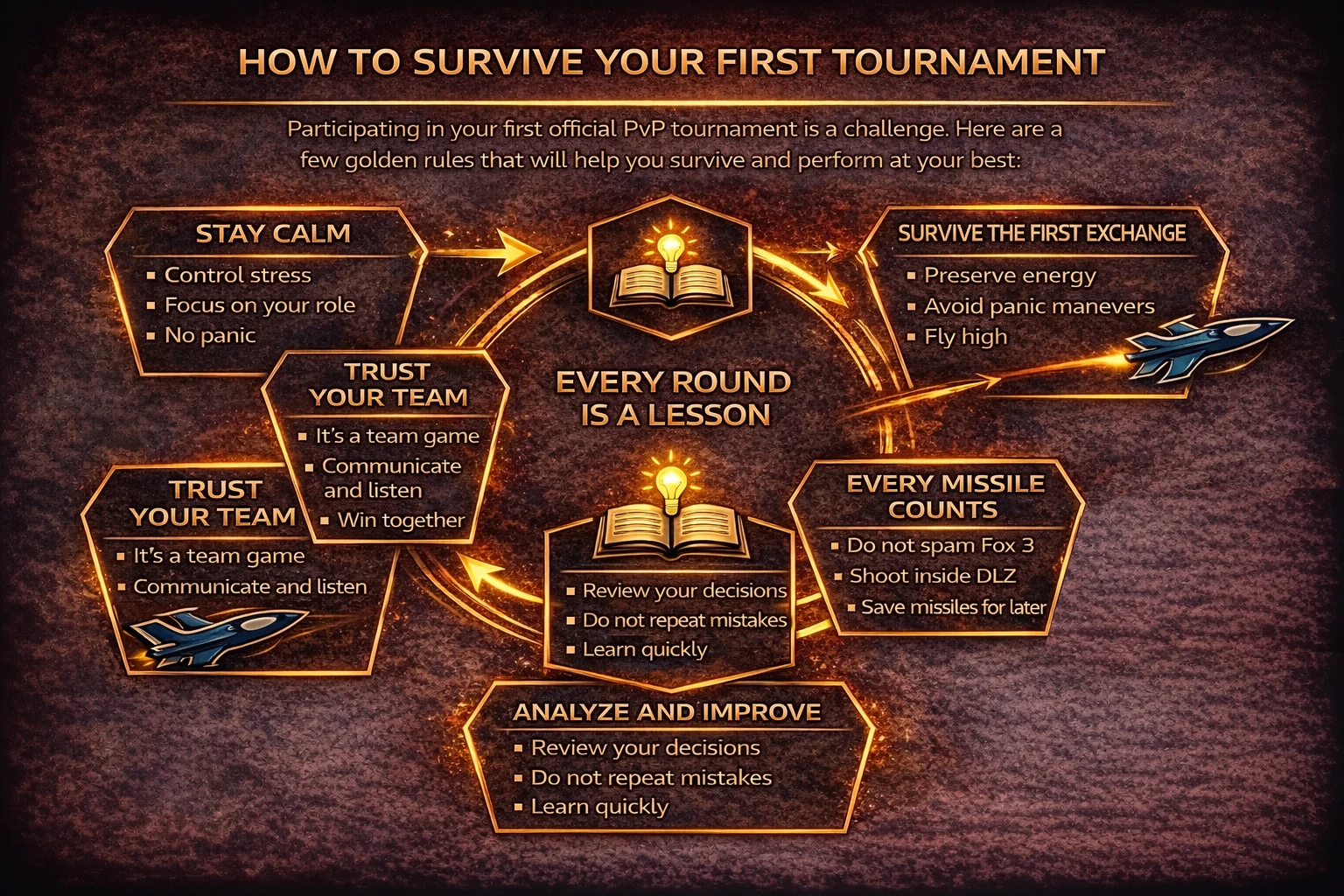
Your first official PvP tournament can be intense. The pressure, pace, and responsibility toward your team are significantly higher than on public servers. These principles will help you stay composed and maximize your effectiveness.
1. Stay Calm
- Control stress and breathe steadily
- Focus on your assigned role
- Avoid panic decisions
2. Trust Your Team
- Tournament combat is team-based
- Communicate and listen
- Do not try to win the round alone
3. Survive the First Exchange
- Preserve energy
- Avoid descending too early
- Do not waste energy in unnecessary 9G turns
4. Every Missile Counts
- Do not spam Fox 3
- Fire within the optimal launch zone (DLZ)
- Save missiles for the final phase of the fight
5. Analyze and Improve
- Review your decisions after each round
- Learn from mistakes
- Every round is a lesson
MATCH SCHEDULE
2026 Season – Group Stage
| Date | Mecz | Time | Status |
|---|---|---|---|
| 4 april 2026 | 104th VS ZERO |
15:00 | |
| 4 april 2026 | 45th VS 76th |
18:00 | |
| 5 april 2026 | HRP VS inSKY-2 |
15:00 | |
| 5 april 2026 | TORO VS TFT |
18:00 | |
| 11 april 2026 | inSKY VS LBA |
15:00 | |
| 11 april 2026 | E-TF VS Storks |
18:00 | |
| 12 april 2026 | TDFW VS BFG |
15:00 | |
| 12 april 2026 | 501st VS REDSTAR |
18:00 | |
| 18 april 2026 | 76th VS BEK |
15:00 | |
| 18 april 2026 | 51st VS REDSTAR |
18:00 | |
| 19 april 2026 | PAS VS inSKY-2 |
15:00 | |
| 19 april 2026 | TORO VS 25th |
18:00 | |
| 25 april 2026 | inSKY VS 68th |
15:00 | |
| 25 april 2026 | 9g VS TDFW |
18:00 | |
| 26 april 2026 | E-TF VS HDA |
15:00 | |
| 26 april 2026 | 104th VS Jade Long |
18:00 | |
| 02 may 2026 | 45th VS BEK |
14:00 | |
| 02 may 2026 | TFT VS 25th |
18:00 | |
| 03 may 2026 | Jade Long VS ZERO |
15:00 | |
| 03 may 2026 | HRP VS PAS |
18:00 | |
| 09 may 2026 | Storks VS HDA |
15:00 | |
| 09 may 2026 | 51st VS 501st |
18:00 | |
| 10 may 2026 | LBA VS 68th |
15:00 | |
| 10 may 2026 | 9g VS BFG |
18:00 |
